
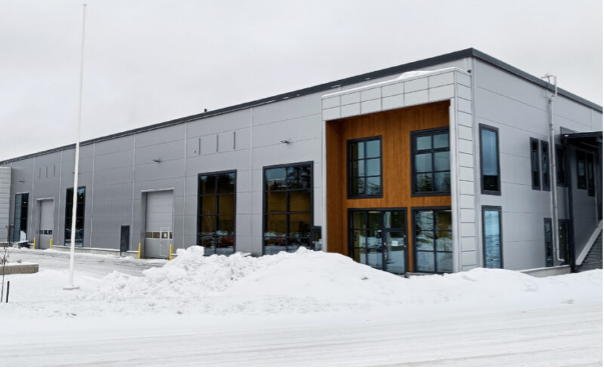
The European Union relies heavily on imports for its supply of rare earth elements. The EU-funded REMHub project addresses this vulnerability by piloting new technologies for the European rare-earth and permanent-magnet value chain. A central part of this strategy involves extracting valuable materials from secondary industrial streams (waste products) to reduce dependence on imports. Weeefiner has joined the REMHub consortium to apply its material recovery expertise to this challenge.
The Finnish greentech company Weeefiner specialises in extracting dissolved metals and nutrients from industrial wastewater and mining effluents. Traditional water treatment often leaves critical raw materials bound in liquid waste. Weeefiner targets these untapped resources to create closed material cycles and turn industrial waste into a secondary raw material source.
Weeefiner was founded in 2017 as a spin-out from the University of Jyväskylä. The company’s core technology, 4D Scavenger, emerged from chemical research that introduced a fourth, chemically active dimension to 3D printing. By integrating ion-capturing functional groups directly into printed materials, the technology combines a defined physical form with highly selective chemical functionality.
University alumni Mikko Hänninen and Elmeri Lahtinen were involved in the technology’s development from the outset. Recognising the market potential of 4D Scavenger, they took the lead in commercialising the innovation and building a company around it.
The liquid waste targeted by these recovery processes rarely resembles natural water sources. Industrial wastewater and acid mine drainage often carry intense colouration and high turbidity. Depending on the specific dissolved metals, residual processing reagents and pH levels, these effluents frequently appear stark blue or deep orange. The waters are also highly acidic or alkaline. Traditional treatment methods simply neutralise and precipitate these complex streams, which leaves valuable trace elements permanently bound in unrecoverable sludge.
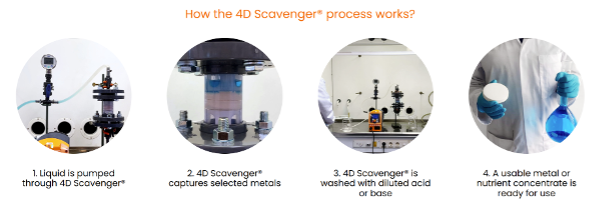
The company’s primary contribution centres on its 4D Scavenger technology. This system uses 3D-printed porous filters that are chemically designed to capture specific target ions. The manufacturing process allows precise control over both the physical structure and the chemical composition of the filters. Weeefiner has previously demonstrated the system’s capacity to extract metals such as copper and cobalt from mine-affected water with high recovery efficiencies.
The system can also be installed in modular containers and deployed on site at industrial plants or mines wherever wastewater requires treatment. In effect, it functions as a highly selective sieve, capturing target metals from any metal-rich wastewater stream.
Is there an approved figure, or should we use this qualitative phrasing?
Within the REMHub project, Weeefiner is working with the University of Helsinki to adapt this filtration technology for rare-earth elements. The team is developing 3D-printed porous polymers containing metal scavengers designed to trap neodymium, samarium and dysprosium.
The collaboration is also developing green solvent systems for the selective leaching and precipitation of these elements. By recovering them from industrial side streams, the project aims to establish a secondary domestic source of the rare earths required for permanent magnets and energy transition technologies in Europe. This helps close the loop in Europe’s emerging circular economy for rare earths.
Confirm that this remains the current scope, since internal work can move ahead of the published page.
Are you interested in rare earth elements, the REMHub initiative, or potential collaboration opportunities? We invite you to share your contact details through the REMHub Interest Form.
The form helps us understand stakeholder interest and intent – whether you are a potential partner, service user, or simply interested in following the initiative. This supports REMHub’s goal of engaging stakeholders across the rare earth element value chain and connecting them through an innovation hub.